Best Non-Fiction Book Structure for Authors Guide
Introduction: Why Structure Makes or Breaks Your Book
Many non-fiction authors struggle with one major problem: they have valuable knowledge, but they don’t know how to organize it into a clear and engaging book.
Without the right non-fiction book structure, your ideas can feel scattered. Readers may get confused, lose interest, or stop reading entirely. Even great content can fail if the structure is weak.
However, the solution is simple. When you use the right structure, your book becomes easy to read, professional, and impactful. A good structure guides readers step-by-step, helping them understand and apply your ideas.
In this guide, you will learn the best non-fiction book structures, how to choose the right one, and how to use it to create a successful book.
What Is a Non-Fiction Book Structure?
A non-fiction book structure is the way your content is organized. It determines:
-
The order of chapters
-
How ideas connect
-
How readers move from start to finish
Think of structure as the blueprint of your book.
Just like a building needs a strong foundation, your book needs a strong structure.
A clear structure helps you:
-
Stay focused
-
Avoid repetition
-
Improve readability
-
Deliver value effectively
Why the Right Structure Is Important
Before learning the types, it’s important to understand why structure matters so much.
Improves Reader Understanding
A structured book helps readers follow your ideas easily.
They know:
-
Where they are
-
What they are learning
-
What comes next
This improves comprehension.
Increases Reader Engagement
When your book flows logically, readers stay interested.
They feel guided instead of lost.
Makes Writing Easier
Structure gives you a clear roadmap.
You always know what to write next.
This saves time and reduces stress.
Improves Professional Quality
Publishers and readers expect professional organization.
A strong structure makes your book look credible.
Best Non-Fiction Book Structure Types
Different books need different structures. Let’s explore the most effective ones.
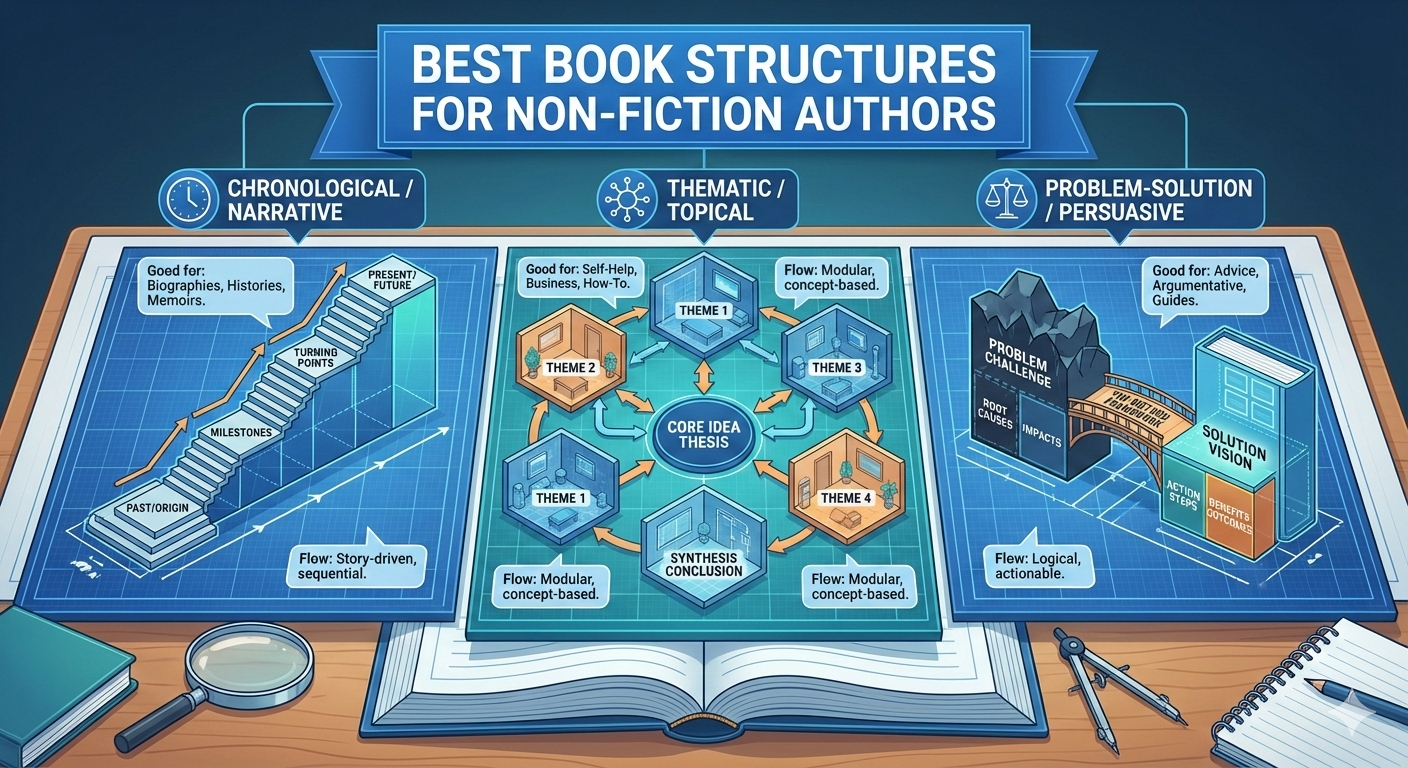
1. Problem–Solution Structure
This is one of the most popular formats.
How it works:
-
Identify a problem
-
Explain why it happens
-
Provide solutions
-
Show results
Best for:
-
Self-help books
-
Business books
-
Health books
Example structure:
-
Chapter 1: Understanding the Problem
-
Chapter 2: Causes
-
Chapter 3: Effects
-
Chapter 4: Solutions
-
Chapter 5: Action Plan
This structure is practical and reader-focused.
2. Step-by-Step Structure
This structure teaches readers a process.
Each chapter represents one step.
Best for:
-
How-to books
-
Skill-based books
-
Educational books
Example:
-
Step 1: Planning
-
Step 2: Preparation
-
Step 3: Execution
-
Step 4: Improvement
Readers love this because it’s easy to follow.
3. Chronological Structure
This structure follows time order.
Events are presented from beginning to end.
Best for:
-
Memoirs
-
History books
-
Case studies
Example:
-
Early stage
-
Middle stage
-
Later stage
This structure tells a story.
4. Thematic Structure
This structure is based on themes or topics.
Each chapter covers a different theme.
Best for:
-
Personal development
-
Psychology
-
Leadership
Example:
-
Chapter 1: Mindset
-
Chapter 2: Habits
-
Chapter 3: Goals
This structure gives flexibility.
5. Modular Structure
Each chapter works independently.
Readers can read in any order.
Best for:
-
Reference books
-
Guides
-
Resource books
Example:
-
Chapter 1: Communication
-
Chapter 2: Productivity
-
Chapter 3: Leadership
Readers can choose what they need.
6. Question-Answer Structure
This structure answers reader questions.
Each chapter answers one question.
Best for:
-
FAQ books
-
Beginner guides
Example:
-
What is leadership?
-
How to become a leader?
-
How to improve leadership?
This structure is reader-friendly.
Step-by-Step Guide to Creating Your Non-Fiction Book Structure
Now let’s see how to create your structure.
Step 1: Define Your Book Goal
Ask yourself:
-
What is the purpose of your book?
-
What do readers want to learn?
Your goal determines your structure.
Step 2: Identify Your Target Reader
Understand your reader:
-
Beginner or expert?
-
Problem or interest?
This helps you organize content properly.
Step 3: List All Your Ideas
Write down everything you want to include.
Do not organize yet.
Just list ideas.
Step 4: Group Similar Ideas
Now group related ideas.
Each group becomes a chapter.
This creates your outline.
Step 5: Arrange Chapters Logically
Put chapters in the correct order.
Ask:
What should readers learn first?
Then next?
This creates flow.
Step 6: Break Chapters into Sections
Each chapter should have:
-
Introduction
-
Main points
-
Summary
This improves clarity.
Ideal Non-Fiction Book Structure Format
Most professional books follow this format:
Front Matter
Includes:
-
Title page
-
Copyright
-
Table of contents
-
Preface
This introduces your book.
Body
This is the main content.
Includes:
-
Chapters
-
Sections
This delivers value.
Back Matter
Includes:
-
Conclusion
-
References
-
Appendix
This completes your book.
Benefits of Using the Right Non-Fiction Book Structure
Using the correct non-fiction book structure gives many advantages.
Improves Writing Speed
You don’t waste time thinking about order.
You just write.
Reduces Writer’s Block
Structure gives direction.
You always know what to do next.
Improves Reader Satisfaction
Readers enjoy organized books.
They learn more easily.
Increases Publishing Success
Publishers prefer structured books.
It shows professionalism.
Best Practices for Non-Fiction Book Structure
Follow these expert tips.
Keep Chapters Focused
Each chapter should have one main idea.
Avoid mixing topics.
Use Logical Flow
Make sure ideas connect naturally.
Avoid jumping randomly.
Use Clear Headings
Headings improve readability.
They help readers navigate.
Start with Basics
Teach simple concepts first.
Then move to advanced ideas.
End with Actionable Advice
Give readers steps to apply learning.
This adds value.
Common Mistakes to Avoid
Many authors make these mistakes.
Avoid them.
No Clear Structure
Writing without planning leads to confusion.
Always create an outline.
Too Much Information in One Chapter
This overwhelms readers.
Break into smaller sections.
Repeating Same Ideas
This makes your book boring.
Be clear and concise.
Poor Chapter Flow
Ideas must connect logically.
Otherwise readers get lost.
Ignoring Reader Needs
Always focus on reader benefit.
Not just your knowledge.
How Professional Publishing Services Help
Creating the perfect non-fiction book structure can be challenging.
Professional publishing companies help you succeed.
Expert Book Structuring
Professionals help organize your ideas properly.
They create clear outlines.
Professional Editing
Editors improve flow and clarity.
They remove errors.
Market-Focused Approach
Professionals know what readers want.
They structure your book for success.
Saves Time
You focus on writing.
Experts handle structure.
Improves Book Quality
Your book becomes professional and polished.
This improves credibility.
Example of a Perfect Non-Fiction Book Structure
Here is a simple example:
Introduction
Explain the purpose.
Chapter 1: Understanding the Topic
Basic concepts.
Chapter 2: Common Problems
Explain challenges.
Chapter 3: Solutions
Provide answers.
Chapter 4: Implementation
Give steps.
Chapter 5: Advanced Strategies
Provide deeper knowledge.