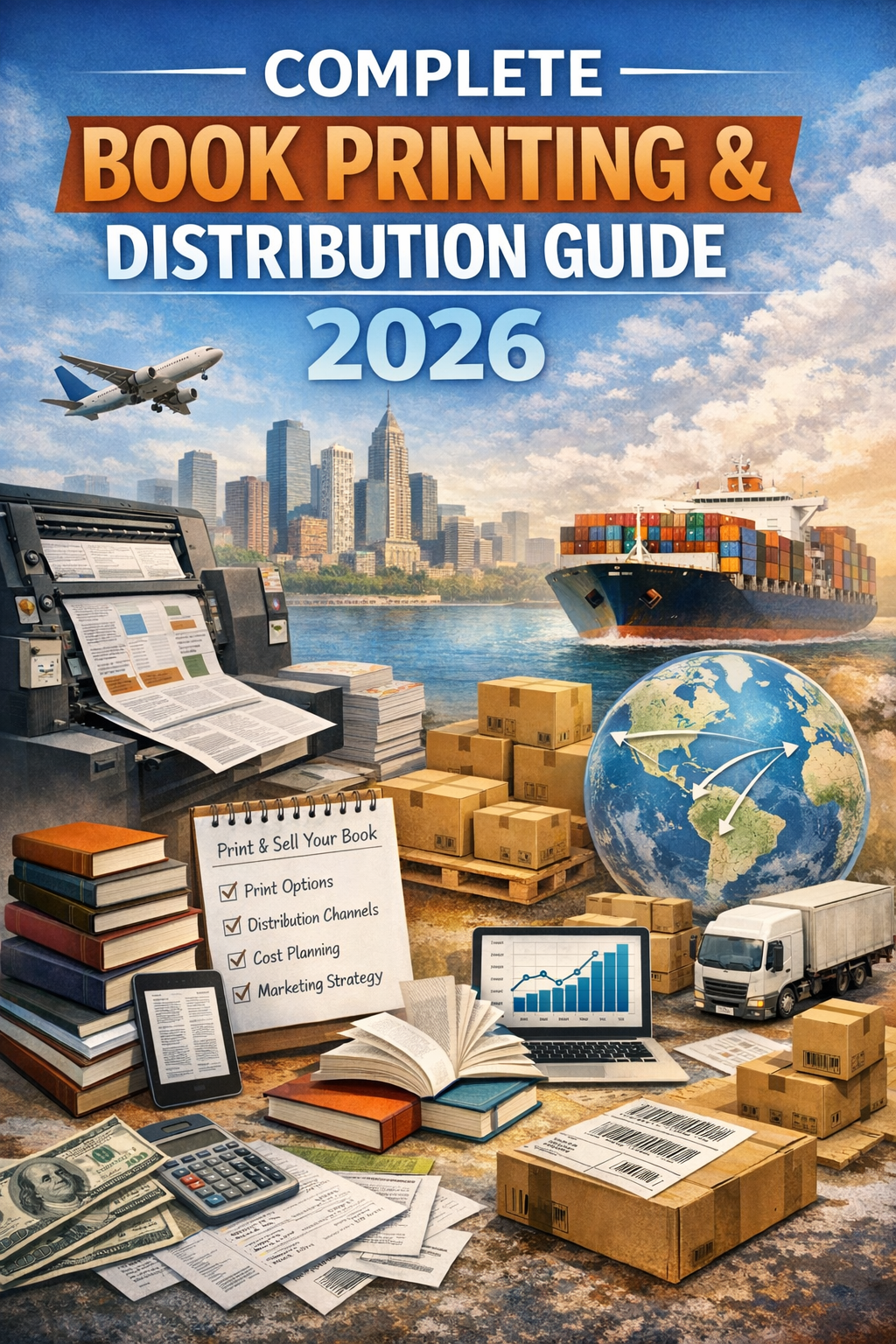
Printing & Distribution Guide 53: Complete Strategy to Successfully Publish and Market Your Book in 2026
Introduction: The Problem and the Solution
Many authors finish writing a book but struggle with what comes next. Printing decisions, distribution channels, pricing, and logistics can feel confusing and overwhelming. A great book can fail simply because readers cannot find or buy it easily.
The solution is understanding book printing and distribution as a strategic process, not just a technical step. When handled correctly, printing and distribution turn your manuscript into a professional product that reaches bookstores, online retailers, libraries, and readers worldwide.
This guide explains the entire process step by step. You will learn how to print efficiently, distribute widely, avoid costly mistakes, and build a system that supports long-term book sales.
What Is Book Printing and Distribution?
Book printing and distribution refers to the combined process of producing physical copies and delivering them to sales platforms or customers.
It includes:
-
Choosing printing methods
-
Selecting formats and materials
-
Managing inventory
-
Shipping books to retailers
-
Listing books on sales channels
Think of it as the bridge between writing a book and selling it successfully.
Step-by-Step Book Printing and Distribution Strategy
Step 1: Decide Your Printing Method
Your first decision is how you will print your book. There are two primary options.
Print-on-Demand (POD)
Print-on-demand prints books only when an order is placed.
Best for:
-
New authors
-
Low budget publishing
-
Testing market demand
Advantages:
-
No inventory storage
-
Lower upfront cost
-
Reduced risk
Limitations:
-
Higher cost per copy
-
Limited customization
-
Slower shipping times
Offset Printing
Offset printing produces large batches at once.
Best for:
-
Established authors
-
Bulk sales
-
Bookstore distribution
Advantages:
-
Lower cost per book in bulk
-
Higher print quality
-
More material options
Limitations:
-
High upfront cost
-
Requires storage space
-
Financial risk if books don’t sell
Most beginners start with POD, then switch to offset when demand grows.
Step 2: Choose the Right Book Format
Your format affects printing cost, reader appeal, and distribution compatibility.
Common formats include:
-
Paperback (most popular)
-
Hardcover (premium feel)
-
Pocket size (portable)
-
Workbook or workbook-style layouts
-
Large print editions
Consider your audience. For example, educational books may benefit from larger trim sizes, while novels usually follow standard dimensions.
Step 3: Select Paper, Ink, and Binding
Quality matters. Readers judge books by physical feel as much as content.
Paper types:
-
Cream paper (best for novels)
-
White paper (best for textbooks)
-
Gloss paper (best for image-heavy books)
Binding options:
-
Perfect binding (most common)
-
Case binding (hardcover)
-
Spiral binding (workbooks)
Choosing cheap materials may save money short term but can harm your reputation long term.
Step 4: Set Up Distribution Channels
Printing alone does not sell books. Distribution determines whether readers can access your work.
Key distribution options:
Online Retailers
These platforms reach global buyers and are essential for modern publishing.
Benefits:
-
Worldwide visibility
-
Automated sales
-
Built-in audience traffic
Bookstores
Physical stores still influence credibility and discovery.
Requirements often include:
-
Wholesale discount
-
Returnability option
-
Professional printing quality
Direct Sales
Selling from your own website or events gives higher profit margins.
Best for:
-
Speakers
-
Coaches
-
Niche authors
Libraries and Institutions
Educational and professional books benefit greatly from library distribution.
Step 5: Assign ISBN and Barcodes
Every book needs identification for retail systems.
You will need:
-
ISBN for each format
-
Barcode for physical copies
-
Metadata (title, author, description, keywords)
Accurate metadata improves discoverability and helps retailers categorize your book correctly.
Step 6: Set Pricing Strategically
Pricing is part of your book printing and distribution strategy, not just a number.
Consider:
-
Printing cost
-
Distribution fees
-
Retail discounts
-
Profit margin
-
Competitor pricing
A price too low reduces perceived value. A price too high limits sales. Balance profitability with market expectations.
Step 7: Manage Inventory and Fulfillment
If you print in bulk, you must manage storage and shipping.
Key tasks:
-
Track stock levels
-
Monitor sales velocity
-
Restock before running out
-
Package books securely
Poor inventory management leads to delays, lost sales, and negative customer experiences.
Benefits of Strong Book Printing and Distribution
When your system is built correctly, you gain long-term advantages.
Wider Market Reach
Your book becomes available globally, not just locally.
Professional Credibility
Retail-ready printing increases trust from bookstores and readers.
Higher Sales Potential
Multiple distribution channels multiply buying opportunities.
Scalable Growth
A strong system supports future books without starting from scratch.
Best Practices for Book Printing and Distribution
Following proven methods improves efficiency and reduces risk.
Standardize Your Book Specs
Use industry-standard sizes and formats whenever possible. Retailers prefer books that match shelf dimensions and shipping requirements.
Always Order a Proof Copy
Before mass printing, review a physical proof.
Check:
-
Text alignment
-
Margins
-
Color accuracy
-
Cover finish
Digital previews cannot reveal all printing issues.
Optimize Your Cover for Print
A cover that looks great on screen may fail in print.
Ensure:
-
Correct spine width
-
Proper bleed margins
-
CMYK color mode
-
High resolution images
Offer Returnability for Retailers
Many bookstores only stock books that can be returned if unsold. While this adds risk, it increases store acceptance.
Track Distribution Performance
Monitor which channels generate sales.
Focus on:
-
Conversion rates
-
Regional demand
-
Platform performance
Then invest more in channels that work best.
Common Mistakes to Avoid
Avoiding errors saves time, money, and frustration.
Printing Too Many Copies Too Soon
Bulk printing without demand often leads to unsold inventory.
Choosing the Cheapest Printer
Low-cost printers may deliver poor quality or delays.
Ignoring Distribution Terms
Some distributors require exclusivity or specific pricing structures.
Skipping Professional Formatting
Incorrect formatting causes printing errors and rejection from retailers.
Not Planning Shipping Costs
International shipping can significantly reduce profits if not calculated early.
Why Choose a Professional Book Printing and Distribution Service
Many authors try to manage printing and distribution alone. While possible, professional services offer significant advantages.
Industry Expertise
Professionals understand:
-
Retail standards
-
Printer specifications
-
Distribution requirements
This reduces costly trial and error.
Faster Production Time
Experienced providers streamline the process through established systems and partnerships.
Higher Print Quality
Professional printers use advanced equipment and calibrated color systems for consistent results.
Retail-Ready Compliance
A professional service ensures your book meets retailer requirements such as:
-
Barcode placement
-
Trim size standards
-
Metadata formatting
Logistics Support
Managing shipping, inventory, and returns can be complex. Professional companies handle these tasks so authors can focus on writing and marketing.
Advanced Distribution Strategies for 2026
Publishing continues to evolve. Modern authors must adapt to current trends.
Global Print Networks
International printing partners allow books to be produced closer to buyers, reducing shipping costs and delivery time.
Hybrid Distribution Models
Many successful authors now combine:
-
Print-on-demand for online sales
-
Offset printing for events
-
Direct sales for profit maximization
Data-Driven Printing Decisions
Sales analytics help determine when to switch from POD to bulk printing. Printing based on real demand reduces financial risk.
Multi-Format Expansion
Offering multiple formats increases revenue opportunities.
Consider:
-
Hardcover edition
-
Special collector edition
-
Workbook companion
-
Large print version
Each format attracts different buyers.
Checklist: Book Printing and Distribution Readiness
Before publishing, confirm these items:
-
Manuscript professionally formatted
-
Cover designed for print
-
ISBN assigned
-
Pricing calculated
-
Printer selected
-
Distribution channels chosen
-
Proof copy approved
-
Metadata optimized
If all boxes are checked, your book is ready for production.