Professional Book Research for Authors: Complete Guide
Introduction: Why Many Authors Struggle With Book Research
One of the biggest challenges authors face is research. Many writers have great ideas, but they don’t know how to gather accurate and useful information.
Without proper book research for authors, your book may feel weak, incomplete, or unreliable. Readers today expect well-researched content. They want facts, examples, and real value.
Poor research can damage your credibility. It can also lead to errors, reader criticism, and negative reviews.
However, professional authors follow a clear research process. They collect reliable information, organize it properly, and use it effectively in their books.
The good news is that you can learn the same professional methods. In this guide, you will discover how to research for a book like a professional author.
What Is Book Research for Authors?
Book research for authors is the process of collecting information to support your book content.
This includes:
-
Facts
-
Data
-
Examples
-
Case studies
-
Expert insights
Research makes your book accurate, credible, and valuable.
It also helps you write with confidence.
Why Research Is Important for Writing a Book
Professional research improves your book in many ways.
Improves Credibility
Well-researched books build trust.
Readers believe your content.
Adds Depth and Value
Research helps you provide detailed information.
This improves quality.
Prevents Errors
Research helps avoid mistakes.
Accuracy is essential.
Makes Writing Easier
When you have information ready, writing becomes faster.
You don’t struggle for ideas.
Step-by-Step Guide: Book Research for Authors
Let’s explore the professional research process.
Step 1: Define Your Book Topic Clearly
Before starting research, define your topic.
Ask yourself:
-
What is your book about?
-
What problem does it solve?
-
Who is your target reader?
Clear focus improves research quality.
Step 2: Identify Research Goals
Know what information you need.
For example:
-
Statistics
-
Examples
-
Expert opinions
-
Case studies
This saves time.
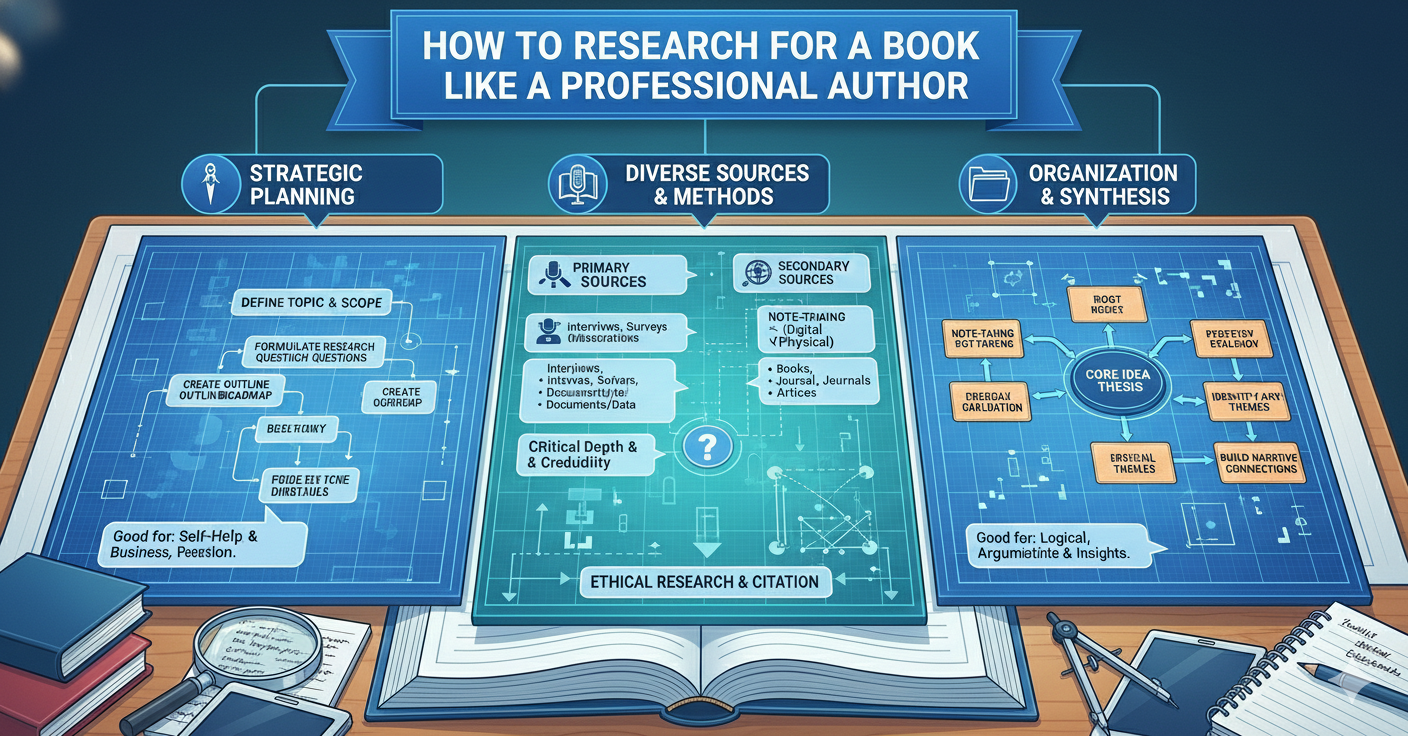
Step 3: Create a Research Plan
Professional authors plan research.
Your plan should include:
-
Topics to research
-
Sources to use
-
Timeline
This keeps you organized.
Step 4: Use Multiple Research Sources
Professional authors never rely on one source.
Use different sources.
Primary Sources
Original information.
Examples:
-
Interviews
-
Surveys
-
Personal experience
These are very valuable.
Secondary Sources
Information created by others.
Examples:
-
Books
-
Journals
-
Articles
These provide knowledge.
Step 5: Take Organized Notes
Note-taking is essential.
Write:
-
Key points
-
Important ideas
-
Sources
Organized notes save time later.
Step 6: Verify Information
Professional authors always verify facts.
Check:
-
Accuracy
-
Source reliability
Avoid false information.
Step 7: Organize Research Into Categories
Group research by topics.
Each group becomes a chapter.
This simplifies writing.
Step 8: Use Research to Support Your Ideas
Research should support your ideas.
Do not copy.
Use research to explain and strengthen your content.
Best Research Methods Used by Professional Authors
Professional authors use proven research methods.
Reading Books on the Topic
Books provide deep knowledge.
They are reliable.
Interviewing Experts
Experts provide valuable insights.
This adds credibility.
Studying Real-Life Examples
Examples make your book practical.
Readers understand better.
Observing and Experiencing
Personal experience adds originality.
This makes your book unique.
Using Case Studies
Case studies show real results.
They improve trust.
How to Organize Research Effectively
Good organization is important.
Use simple methods.
Use Research Files
Create folders for topics.
Example:
-
Chapter 1 folder
-
Chapter 2 folder
Use Notes and Summaries
Write summaries.
This saves time.
Create an Outline
Add research to your outline.
This improves flow.
Benefits of Professional Book Research for Authors
Professional research provides many advantages.
Improves Book Quality
Your book becomes detailed.
Readers get value.
Builds Authority
You become an expert.
Readers trust you.
Increases Reader Satisfaction
Readers enjoy useful content.
This improves reviews.
Improves Publishing Success
Publishers prefer researched books.
Helps Marketing
Research makes your book informative.
This attracts readers.
Best Practices for Book Research for Authors
Follow these professional tips.
Start Research Early
Do not wait.
Research before writing.
Focus on Relevant Information
Avoid unnecessary information.
Stay focused.
Use Reliable Sources
Choose trusted sources.
Avoid unreliable information.
Keep Track of Sources
This helps later.
Update Research
Use current information.
This improves accuracy.
Common Mistakes Authors Must Avoid
Avoid these mistakes.
Not Doing Enough Research
This weakens your book.
Research properly.
Using Unreliable Sources
This damages credibility.
Always verify.
Copying Information
Never copy.
Use your own words.
Poor Organization
Disorganized research wastes time.
Stay organized.
Over-Researching
Too much research delays writing.
Balance research and writing.
How Professional Publishing Services Help Authors With Research
Professional publishing companies help authors succeed.
They provide research support.
Research Guidance
Experts guide research process.
Content Planning
They help organize research.
Professional Editing
Editors improve accuracy.
Fact Checking
They verify information.
Improves Book Quality
Professional support makes your book better.
Research Tips for Fiction Authors
Research is important for fiction too.
It improves realism.
Research Locations
Understand places.
Research Characters
Understand professions.
Research History
Understand time period.
How Much Research Is Enough?
Research until you:
-
Understand topic clearly
-
Can explain confidently
-
Can answer reader questions
Then start writing.
Signs of Well-Researched Book
Professional books have:
-
Accurate information
-
Clear explanations
-
Real examples
-
Credible content
Readers trust such books.
Professional Author Research Workflow Example
Here is a simple workflow.
Step 1: Define topic
Step 2: Research information
Step 3: Take notes
Step 4: Organize research
Step 5: Create outline
Step 6: Start writing
Why Research Makes You a Better Author
Research improves your writing skills.
You learn more.
You think clearly.
You write better.
You become professional.