Best Book Writing Tools 2026: Complete Author Guide
Writing a book is easier today than ever before. However, many authors still struggle with organization, editing, and staying productive. Ideas get lost. Drafts become messy. Editing takes longer than expected.
This is exactly why choosing the right book writing tools 2026 can make a huge difference.
The right tools help you:
-
Organize your ideas
-
Write faster
-
Edit professionally
-
Format your manuscript
-
Prepare for publishing
In this complete guide, you’ll discover the best tools, how to use them step-by-step, and how professional authors finish books successfully.
Why Authors Need Book Writing Tools in 2026
Writing a book is not just typing words. It involves multiple stages, including:
-
Planning
-
Drafting
-
Editing
-
Proofreading
-
Formatting
Without proper tools, this process becomes slow and stressful.
Modern writing tools help you:
-
Save time
-
Stay organized
-
Improve writing quality
-
Reduce errors
-
Increase productivity
Most importantly, they help you finish your book.
Step-by-Step Guide to the Best Book Writing Tools 2026
Let’s explore the tools based on each stage of writing.
H2: Book Writing Tools 2026 for Drafting Your Manuscript
Drafting is the most important stage. You need a distraction-free and organized writing environment.
H3: 1. Microsoft Word
Microsoft Word is one of the most popular writing tools.
Why authors use it:
-
Simple and easy to use
-
Works offline
-
Supports large documents
-
Industry standard format
Best for:
-
Beginners
-
Academic writers
-
Professional authors
It is reliable and familiar.
H3: 2. Google Docs
Google Docs is perfect for cloud-based writing.
Key features:
-
Auto-save
-
Access anywhere
-
Easy sharing
-
Collaboration
Best for:
-
Writers working on multiple devices
-
Co-authors
You never lose your work.
H3: 3. Literature & Latte Scrivener
Scrivener is designed specifically for authors.
Powerful features:
-
Chapter organization
-
Drag-and-drop structure
-
Notes and research storage
-
Distraction-free writing
Best for:
-
Novel writers
-
Long books
It gives full control over your manuscript.
H2: Book Writing Tools 2026 for Planning and Organization
Planning is where many authors fail. These tools help you stay organized.
H3: 4. Notion Labs Notion
Notion is an all-in-one workspace.
Authors use it for:
-
Plot planning
-
Character profiles
-
Chapter outlines
-
Research storage
It keeps everything in one place.
H3: 5. Evernote Corporation Evernote
Evernote is excellent for capturing ideas.
Useful features:
-
Quick notes
-
Voice notes
-
Idea storage
-
Easy search
Perfect for authors who get ideas anytime.
H2: Book Writing Tools 2026 for Editing and Proofreading
Editing improves your writing quality.
H3: 6. Grammarly Grammarly
Grammarly is essential for editing.
It checks:
-
Grammar
-
Spelling
-
Clarity
-
Tone
It improves professionalism.
H3: 7. Hemingway App Hemingway Editor
This tool improves readability.
It helps you:
-
Write clearly
-
Remove complex sentences
-
Improve flow
Your book becomes easier to read.
H3: 8. Orpheus Technology ProWritingAid
This is an advanced editing tool.
Features include:
-
Style suggestions
-
Structure improvements
-
Detailed reports
It is excellent for serious authors.
H2: Book Writing Tools 2026 for Formatting Your Book
Formatting is required for publishing.
H3: 9. 180g Vellum
Vellum is one of the best formatting tools.
It helps create:
-
Print books
-
eBooks
-
Professional layouts
Formatting becomes easy.
H3: 10. Atticus Atticus
Atticus is an all-in-one writing and formatting tool.
It allows:
-
Writing
-
Editing
-
Formatting
All in one platform.
Benefits of Using Book Writing Tools 2026
Using the right tools offers many advantages.
Faster Writing
Tools reduce distractions.
You focus on writing.
Better Organization
You manage:
-
Chapters
-
Notes
-
Research
Everything stays organized.
Professional Editing
Your book becomes:
-
Clear
-
Correct
-
Professional
This improves reader experience.
Easier Publishing
Formatting tools prepare your manuscript.
Publishing becomes simple.
Best Practices for Using Book Writing Tools
Using tools correctly is important.
Practice 1: Choose One Main Writing Tool
Avoid switching tools constantly.
Stick with one primary tool.
Practice 2: Plan Before Writing
Use planning tools for:
-
Outline
-
Structure
This saves time later.
Practice 3: Edit Separately
Do not edit while writing.
First draft → Edit later.
Practice 4: Backup Your Work
Always keep backups.
Use:
-
Cloud storage
-
External drives
Never risk losing your manuscript.
Common Mistakes to Avoid
Many authors misuse writing tools.
Avoid these mistakes.
Mistake 1: Using Too Many Tools
Too many tools create confusion.
Keep your system simple.
Mistake 2: Ignoring Editing Tools
Editing tools improve quality.
Never skip editing.
Mistake 3: Not Learning the Tool Properly
Learn features fully.
This improves productivity.
Mistake 4: Focusing Only on Tools
Tools help—but writing matters most.
Your ideas are more important.
How to Choose the Right Book Writing Tools 2026
Every author is different.
Choose tools based on your needs.
If You Are a Beginner
Start with:
-
Microsoft Word
-
Google Docs
-
Grammarly
Simple and effective.
If You Are Writing a Novel
Use:
-
Scrivener
-
Notion
-
ProWritingAid
Better for complex books.
If You Want Professional Publishing
Use:
-
Vellum
-
Atticus
They produce professional formatting.
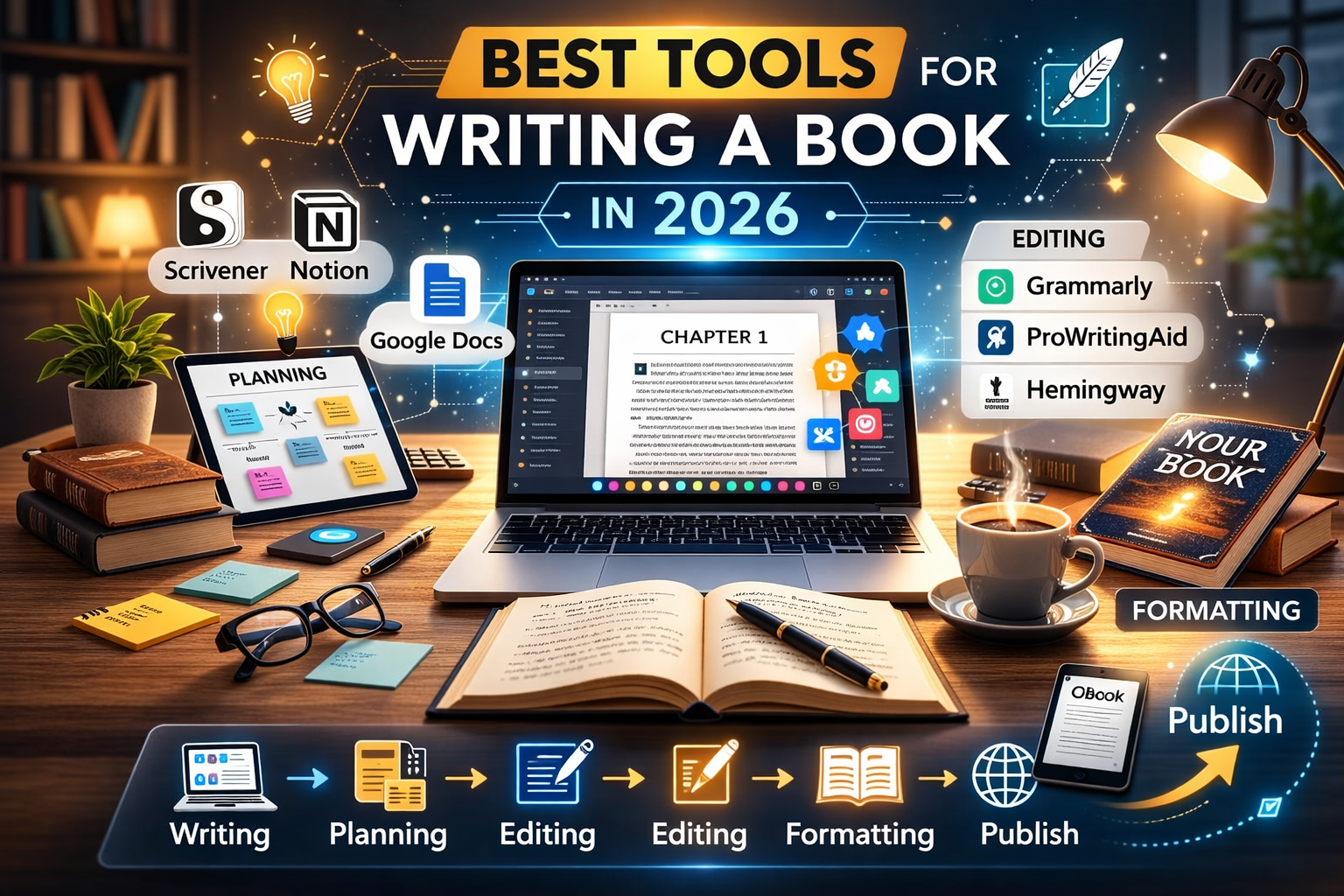
Recommended Tool Combination Used by Professional Authors
Many successful authors use this workflow:
Planning: Notion
Writing: Scrivener
Editing: Grammarly + ProWritingAid
Formatting: Vellum
This is a proven system.
Why Authors Choose Professional Publishing Services
Even with the best tools, professional help is valuable.
Professional publishing services provide:
-
Expert editing
-
Professional formatting
-
Cover design
-
Publishing support
This increases book quality.
Professional Services Save Time
You focus on writing.
Experts handle technical work.
Improve Book Quality
Professional editing improves credibility.
Readers trust quality books.
Increase Publishing Success
Professionally prepared books perform better.
They sell more.
Future of Book Writing Tools
Writing tools continue improving.
Future tools will offer:
-
Better organization
-
Faster editing
-
Easier publishing
Authors will finish books faster.