Copyediting vs Proofreading: Key Differences Explained
Introduction: Why Understanding Copyediting vs Proofreading Matters
You’ve finished writing your manuscript. After weeks or months of hard work, you’re ready to publish. But there’s one big question: do you need copyediting or proofreading?
Many authors confuse these two services. Some think they are the same. Others skip one to save time or money. Unfortunately, this often leads to poor-quality books filled with errors, weak clarity, and negative reviews.
This is where understanding copyediting vs proofreading becomes essential.
Both play different roles. Together, they transform your manuscript into a professional, polished, and publish-ready book.
In this guide, you’ll learn the exact differences, when to use each, and why both are critical for your publishing success.
What Is Copyediting?
Copyediting is the process of improving your manuscript’s clarity, consistency, and correctness. It focuses on the technical and language quality of your writing.
A copyeditor reviews your content carefully and makes changes to improve readability.
What Copyediting Includes
Copyediting focuses on:
-
Grammar correction
-
Sentence structure improvement
-
Fixing punctuation
-
Removing repetition
-
Improving clarity
-
Ensuring consistency
-
Correcting word usage
-
Checking tone and flow
Copyediting goes deeper than basic correction. It improves how your writing communicates your message.
Example of Copyediting
Original sentence:
She quickly ran very fast to reach at the station.
Copyedited version:
She ran quickly to reach the station.
The meaning stays the same, but the sentence becomes clearer and more professional.
What Is Proofreading?
Proofreading is the final step before publishing. It focuses on catching small surface-level errors.
A proofreader checks your manuscript after editing is complete.
What Proofreading Includes
Proofreading focuses on:
-
Spelling mistakes
-
Typing errors
-
Missing words
-
Incorrect punctuation
-
Formatting issues
-
Page number errors
-
Layout consistency
Proofreading does not improve sentence quality. It simply fixes remaining mistakes.
Example of Proofreading
Sentence:
She ran quickly to reach the staton.
Proofread version:
She ran quickly to reach the station.
Only the spelling error is fixed.
Copyediting vs Proofreading: The Key Differences
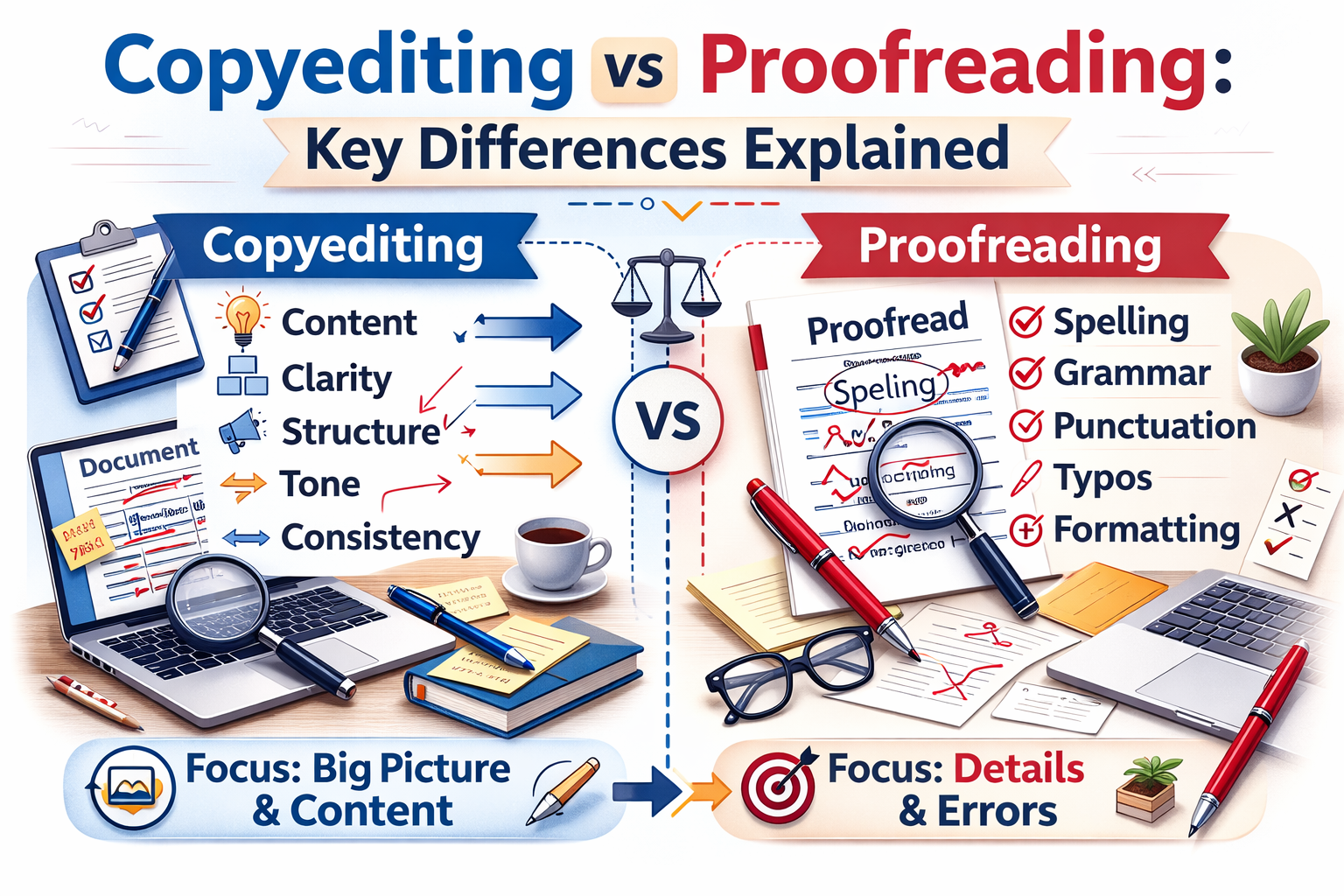
Understanding copyediting vs proofreading is easier when you compare them directly.
Purpose
Copyediting:
-
Improves clarity and readability
Proofreading:
-
Fixes final errors
Stage in Publishing
Copyediting:
-
Done before proofreading
Proofreading:
-
Done last
Level of Editing
Copyediting:
-
Deep editing
Proofreading:
-
Surface correction
Focus Area
Copyediting:
-
Grammar, clarity, consistency
Proofreading:
-
Spelling, typos, formatting
Major vs Minor Changes
Copyediting:
-
Makes sentence improvements
Proofreading:
-
Makes minor corrections
Why Copyediting Comes Before Proofreading
The editing process follows a clear order.
Step 1: Writing
Step 2: Copyediting
Step 3: Proofreading
Step 4: Publishing
If you proofread first, you may waste time fixing sentences that will later change.
Copyediting improves the manuscript first. Proofreading then cleans the final version.
Step-by-Step Editing Process Explained
Here is how professional publishing works.
Step 1: Complete Your Manuscript
Finish writing your full draft.
Do basic self-editing before sending it to professionals.
Step 2: Copyediting Stage
A copyeditor improves:
-
Language
-
Clarity
-
Grammar
-
Flow
This step ensures professional writing quality.
Step 3: Layout and Formatting
Your manuscript is formatted for publishing.
This includes:
-
Page layout
-
Chapter design
-
Typography
Step 4: Proofreading Stage
Proofreading checks the final formatted version.
This ensures:
-
No typos
-
No layout mistakes
-
No missing words
Step 5: Publishing
Your book is ready for publishing.
Why Copyediting Is Important
Copyediting improves the reader experience.
Benefits of Copyediting
1. Improves Readability
Clear writing keeps readers engaged.
Confusing sentences make readers stop reading.
2. Builds Author Credibility
Professional writing builds trust.
Poor grammar damages your reputation.
3. Enhances Book Quality
Professional editing makes your book look professionally written.
4. Prevents Negative Reviews
Many bad reviews mention grammar mistakes.
Copyediting prevents this.
5. Improves Communication
Your message becomes easier to understand.
Why Proofreading Is Important
Proofreading ensures your book is error-free before publishing.
Benefits of Proofreading
1. Removes Final Mistakes
Even edited books can have small errors.
Proofreading catches them.
2. Ensures Professional Presentation
Clean books look professional.
3. Protects Your Brand
Readers judge authors by quality.
Proofreading protects your reputation.
4. Prevents Embarrassing Errors
Small typos can harm your credibility.
5. Ensures Publishing Readiness
Proofreading prepares your book for release.
When Do You Need Copyediting?
You need copyediting if:
-
You finished writing your manuscript
-
You want to improve clarity
-
You want professional quality
-
English is not your first language
-
You plan to publish professionally
Most authors need copyediting.
When Do You Need Proofreading?
You need proofreading if:
-
Editing is already complete
-
Your book is formatted
-
You are ready to publish
-
You want final error checking
Proofreading is always the last step.
Do You Need Both Copyediting and Proofreading?
Yes. Professional publishing requires both.
Copyediting and proofreading serve different purposes.
Skipping one can reduce quality.
Copyediting fixes quality.
Proofreading fixes accuracy.
Both ensure professional publishing.
Common Mistakes Authors Make
Understanding copyediting vs proofreading helps avoid these mistakes.
Mistake 1: Thinking They Are the Same
They are different services.
Both are necessary.
Mistake 2: Skipping Copyediting
This leads to:
-
Weak writing
-
Poor readability
-
Negative reviews
Mistake 3: Skipping Proofreading
This leads to:
-
Typos in published books
-
Unprofessional appearance
Mistake 4: Doing Only Self-Editing
Authors miss their own mistakes.
Professional editors catch more errors.
Mistake 5: Hiring Only One Service
Both services are required for best results.
Copyediting vs Proofreading: Which Is More Important?
Both are equally important.
They work together.
Copyediting improves quality.
Proofreading ensures perfection.
You need both for professional publishing.
Best Practices for Authors
Follow these best practices for better results.
Finish Writing First
Do not edit while writing.
Complete your manuscript.
Self-Edit Before Hiring Professionals
Remove obvious mistakes.
This saves editing cost.
Hire Professional Editors
Professional editors improve quality.
Do Not Skip Proofreading
Proofreading is essential before publishing.
Plan Editing Budget
Editing is an investment.
It improves your book success.
Why Professional Editing Services Are Worth It
Many authors try to skip professional editing.
This is a mistake.
Professional editing improves your book significantly.
Professional Editors Have Experience
They know:
-
Grammar rules
-
Publishing standards
-
Editing techniques
They Improve Book Quality
Professional editing makes your book competitive.
They Save Time
Editing yourself takes longer.
Professionals work faster.
They Improve Reader Experience
Better books attract more readers.
They Help You Publish Professionally
Publishing companies require professional editing.
How Professional Publishing Companies Help
A professional publishing company provides complete editing support.
This includes:
-
Copyediting
-
Proofreading
-
Formatting
-
Publishing preparation
They ensure high-quality publishing.
How Copyediting and Proofreading Affect Book Sales
Professional editing improves sales indirectly.
Better Reviews
Readers leave positive reviews for well-edited books.
Higher Credibility
Professional books attract more readers.
Strong Author Brand
Quality books build your reputation.
Better Reader Experience
Happy readers recommend your book.
Copyediting vs Proofreading for Self-Publishing Authors
Self-publishing authors especially need both services.
Traditional publishers provide editing.
Self-publishers must arrange it themselves.
Skipping editing leads to poor-quality books.
Professional editing makes your book competitive.
Signs Your Manuscript Needs Copyediting
You need copyediting if:
-
Sentences feel confusing
-
Grammar mistakes exist
-
Writing feels unpolished
-
Feedback mentions clarity issues
Signs Your Manuscript Needs Proofreading
You need proofreading if:
-
Manuscript is fully edited
-
Book is formatted
-
You are ready to publish
Cost of Copyediting vs Proofreading
Copyediting usually costs more.
Because it involves deeper editing.
Proofreading costs less.
Because it involves minor corrections.
Both are worth the investment.
How Editing Improves Publishing Success
Professional editing improves:
-
Book quality
-
Reader trust
-
Author reputation
-
Sales potential
It increases your chances of success.