Printing & Distribution Guide 83: Complete Strategy to Successfully Publish and Market Your Book in 2026
Introduction: The Biggest Publishing Challenge Authors Face
Many authors believe finishing a manuscript is the hardest step. In reality, printing and distributing a book is often more complex. Poor print quality, limited distribution channels, or high shipping costs can ruin a book’s chances of success.
The solution is a clear book printing and distribution strategy. When you understand formats, suppliers, pricing, and logistics, your book becomes easier to sell, ship, and scale globally.
This guide explains everything step by step so you can confidently print, distribute, and market your book in 2026.
Step-by-Step Book Printing and Distribution Strategy
Step 1: Choose Your Printing Method
Your first decision is how your book will be printed. Each method fits different goals.
Offset Printing
Best for large print runs.
Advantages:
-
Lowest cost per copy
-
High print quality
-
Ideal for bookstores and bulk sales
Disadvantages:
-
High upfront cost
-
Requires storage space
Print-on-Demand (POD)
Best for new or self-published authors.
Advantages:
-
No inventory needed
-
Print only when ordered
-
Lower financial risk
Disadvantages:
-
Higher cost per copy
-
Limited customization
Short-Run Digital Printing
Best middle option.
Advantages:
-
Small batches
-
Lower risk than offset
-
Faster turnaround
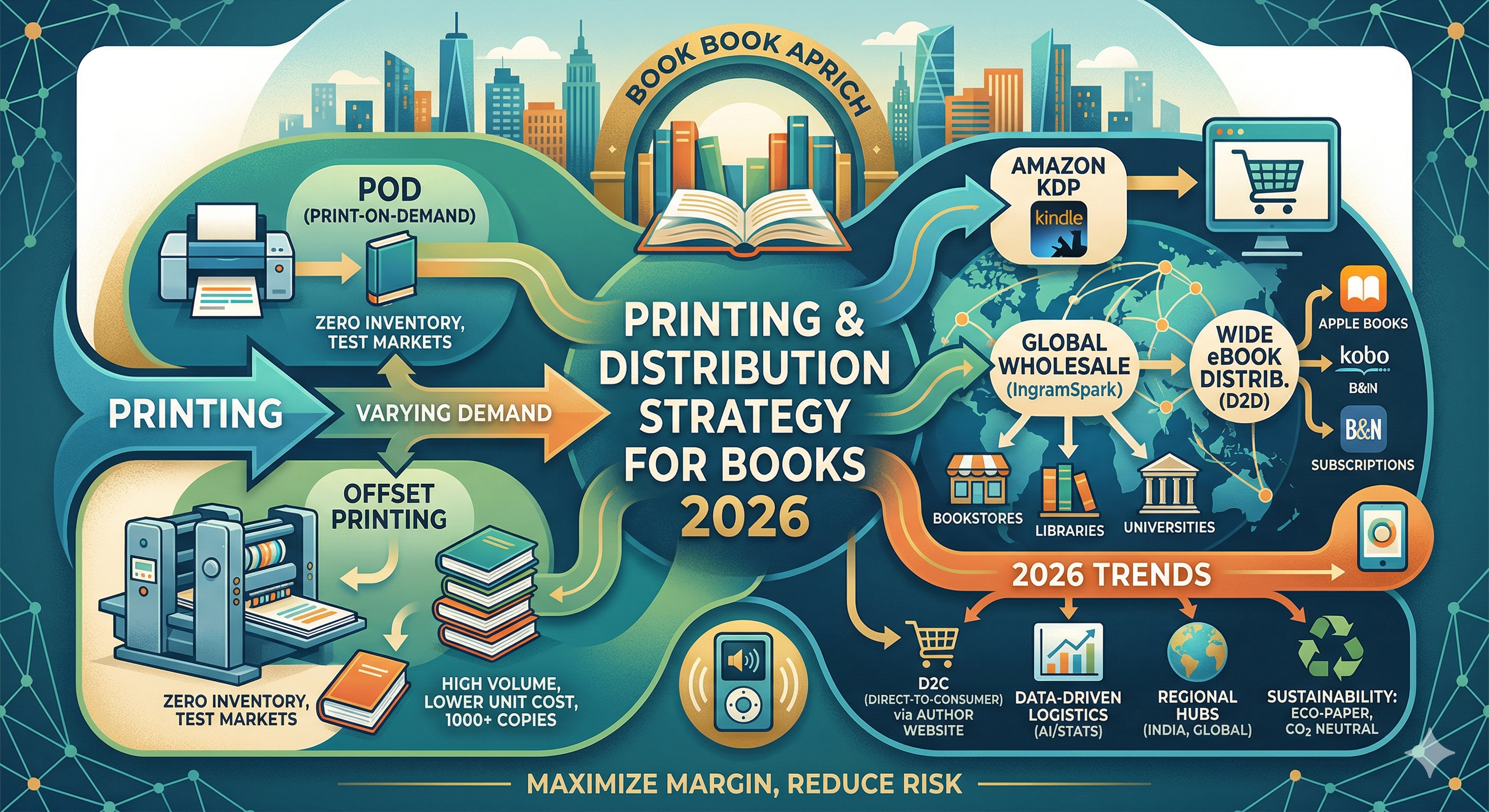
Most authors in 2026 start with POD and move to offset once sales grow.
Step 2: Select the Right Book Format
Your format affects printing cost, reader experience, and distribution.
Common formats:
-
Paperback
-
Hardcover
-
Spiral bound
-
Workbook format
-
Large print edition
Tips:
-
Fiction usually sells best in paperback.
-
Educational books often work better in workbook or spiral format.
-
Hardcover suits premium editions.
Step 3: Decide Paper, Ink, and Binding Quality
Printing quality directly affects reader perception.
Key choices include:
-
Paper weight (70–100 GSM common)
-
Cream vs white pages
-
Matte vs glossy covers
-
Perfect binding vs case binding
Best practice:
Match your book’s purpose with its materials. For example, novels usually use cream paper, while photo books require glossy pages.
Step 4: Calculate Printing Costs
Many authors underprice their books because they miscalculate costs.
Include:
-
Printing price per copy
-
Shipping fees
-
Storage costs
-
Platform commissions
-
Retail discounts
Simple formula:
Retail Price = Total Cost × 2.5 to 3
This ensures you maintain profit margins after distributor and retailer cuts.
Step 5: Choose Distribution Channels
Your distribution plan determines how readers access your book.
Online Retailers
Most important channel today.
Benefits:
-
Global reach
-
Automated fulfillment
-
Built-in audience
Wholesale Distribution
Used for bookstores and libraries.
Benefits:
-
Professional credibility
-
Larger bulk orders
-
Higher visibility
Direct Sales
Selling through your own website or events.
Benefits:
-
Highest profit margins
-
Direct reader relationship
-
Full pricing control
Best strategy:
Combine all three for maximum reach.
Step 6: Set Up ISBN and Metadata
Without proper metadata, distributors cannot list your book.
Required elements:
-
ISBN
-
Title and subtitle
-
Author name
-
Category
-
Keywords
-
Description
-
Price
Strong metadata improves discoverability and sales rankings.
Step 7: Plan Logistics and Shipping
Distribution is not just about availability. Delivery speed matters.
Consider:
-
Domestic vs international shipping
-
Packaging protection
-
Delivery partners
-
Return policies
Fast and reliable shipping increases reader trust and reduces refunds.
Benefits of a Strong Book Printing and Distribution Plan
Wider Market Reach
Your book becomes available in multiple regions, formats, and stores. This multiplies visibility and sales potential.
Lower Financial Risk
Strategic printing prevents overstock and reduces wasted inventory.
Professional Brand Image
High-quality printing signals professionalism. Readers judge a book by its cover and physical feel.
Scalability
Once your system works, you can print thousands of copies without changing your workflow.
Best Practices for Book Printing and Distribution in 2026
Use Hybrid Printing Models
Combine print-on-demand with bulk printing. POD handles daily sales, while offset handles large orders.
Test Before Mass Printing
Always order a proof copy. Check:
-
Color accuracy
-
Margin spacing
-
Binding strength
-
Font clarity
Optimize Book Size
Standard trim sizes cost less and distribute faster. Custom sizes may increase printing costs.
Monitor Sales Data
Track which formats and regions sell best. Adjust print quantities accordingly.
Build Relationships With Distributors
Reliable partners ensure faster processing and better placement in stores.
Common Mistakes Authors Should Avoid
Printing Too Many Copies Too Soon
Large print runs without proven demand lead to unsold inventory and storage expenses.
Ignoring Shipping Costs
International shipping can reduce profits if not calculated correctly.
Choosing the Cheapest Printer
Low prices often mean poor paper quality, faded ink, or weak binding.
Skipping Proof Copies
Many authors discover formatting errors only after printing hundreds of copies.
Poor Metadata Optimization
Without proper keywords and categories, readers cannot find your book online.
How Pricing Strategy Impacts Distribution Success
Pricing is not just about profit. It affects retailer willingness to stock your book.
If your price is too high:
-
Stores may refuse to carry it.
-
Readers may choose competitors.
If your price is too low:
-
Profit margins disappear.
-
Distributors earn less and deprioritize your book.
Ideal pricing balances:
-
Printing cost
-
Market competition
-
Reader expectations
-
Distribution discounts
Print-on-Demand vs Bulk Printing: Which Is Better?
| Factor | POD | Bulk Printing |
|---|---|---|
| Startup Cost | Low | High |
| Risk | Minimal | Moderate |
| Per Copy Cost | Higher | Lower |
| Storage | None | Required |
| Best For | New authors | Established sellers |
Recommendation:
Start with POD. Switch to bulk printing once sales stabilize.
Global Distribution Trends in 2026
Publishing is more global than ever. Readers buy books from anywhere in the world.
Key trends:
-
Local printing hubs reduce shipping time.
-
Eco-friendly printing is becoming standard.
-
Regional pricing improves international sales.
-
Digital inventory tracking prevents stockouts.
Authors who adapt to these trends sell faster and scale more efficiently.
Why Authors Should Consider Professional Printing Services
Many writers try to manage printing alone. This often leads to delays, quality issues, and hidden costs.
Professional services provide:
-
Industry-grade printing equipment
-
Access to global distribution networks
-
Expert formatting support
-
Logistics management
-
Cost optimization
Most importantly, they allow authors to focus on writing and marketing instead of managing technical production tasks.
Signs You Need a Professional Distribution Partner
Consider hiring experts if:
-
You plan to sell internationally
-
You want bookstore placement
-
You need large print runs
-
You lack storage space
-
You want faster delivery times
Professional partners reduce operational stress and increase efficiency.
Advanced Distribution Strategies Used by Successful Authors
Regional Printing
Printing copies near buyers reduces shipping cost and delivery time.
Tiered Release Strategy
Launch formats in stages:
-
Ebook
-
Paperback
-
Hardcover
-
Special editions
This keeps sales momentum high for months.
Distributor Incentives
Offer retailers better discounts or marketing materials to encourage stocking.
Bundled Sales
Selling book bundles increases order value and improves inventory turnover.
Checklist Before Printing Your Book
Use this quick checklist to avoid mistakes:
-
Manuscript proofread
-
Layout finalized
-
Cover approved
-
ISBN registered
-
Price calculated
-
Printer tested
-
Proof copy reviewed
-
Distribution channels selected
Completing these steps ensures a smooth publishing process.
Future of Book Printing and Distribution
Technology continues to transform publishing.
Emerging innovations include:
-
AI-assisted print optimization
-
Same-day local printing
-
Smart inventory forecasting
-
Automated global fulfillment
Authors who adapt early will gain a major competitive advantage.